
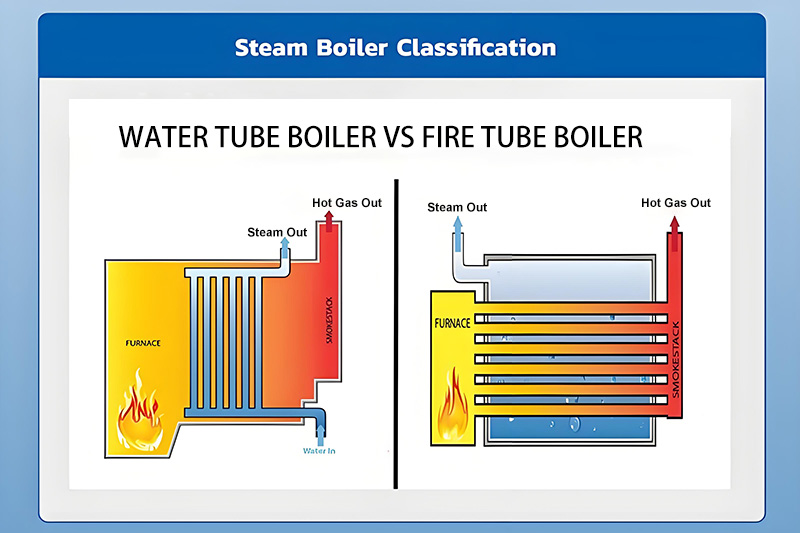
Choosing between a 火管ボイラー and a 水管ボイラー is a critical decision for industries requiring reliable steam production.
Each boiler type offers unique advantages depending on steam capacity, pressure requirements, fuel efficiency, and investment budget.
Quick Summary
- Fire Tube Boilers: Lower cost, simple operation, ideal for small to medium steam demand.
- Water Tube Boilers: Higher efficiency, 高圧能力, suitable for large industrial applications.
- Water tube boilers typically achieve 5–10% higher efficiency.
- Fire tube boilers are easier to maintain and require lower operator skill levels.
- Best choice depends on steam capacity, プレッシャー, および長期的な運用コスト.
1. What Is a Fire Tube Boiler?
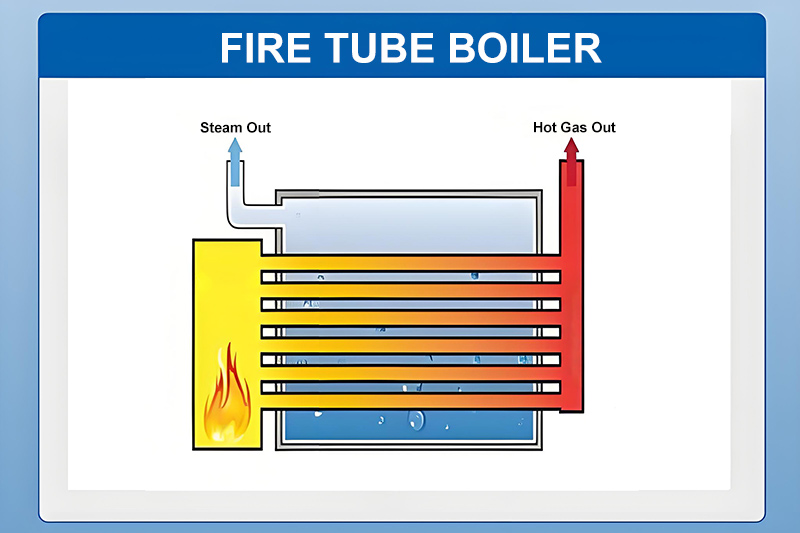
A fire tube boiler is a design where hot combustion gases flow through tubes surrounded by water inside a pressure vessel. Heat transfers through the tube walls to generate steam.
Main Characteristics
- Simple structural design
- Large water storage capacity
- Stable operation
- Lower pressure operation
Typical Applications
- 食品加工工場
- Laundry industries
- Textile factories
- Building heating systems
2. What Is a Water Tube Boiler?
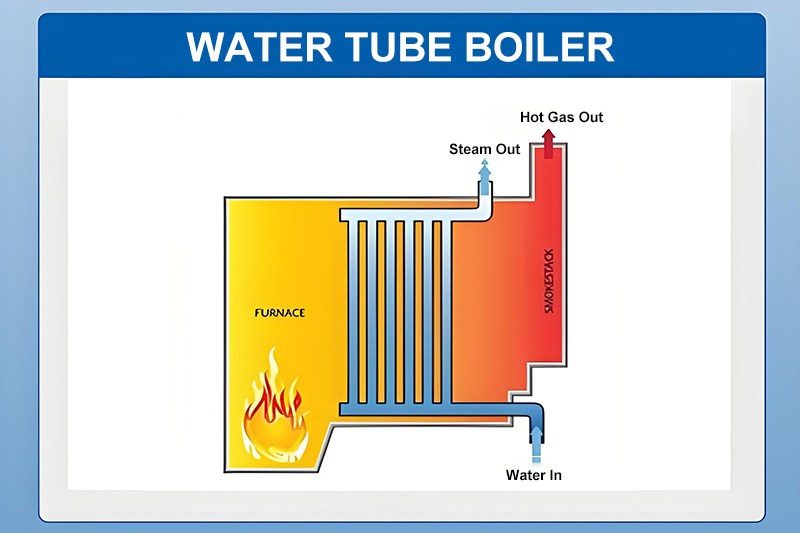
In a water tube boiler, water flows inside tubes while combustion gases circulate externally. This configuration allows faster heat transfer and supports higher pressure steam production.
Main Characteristics
- High-pressure capability
- Fast steam generation
- Higher thermal efficiency
- Suitable for continuous industrial operation
Common Applications
- Power generation plants
- Chemical processing facilities
- Oil and gas industries
- Combined heat and power systems
3. Fire Tube vs Water Tube Boiler: Key Differences
| Feature | Fire Tube Boiler | Water Tube Boiler |
|---|---|---|
| Flow Design | Hot gas inside tubes | Water inside tubes |
| 蒸気圧力 | 低から中程度 | 高圧 |
| 容量 | Small–Medium | Medium–Large |
| 効率 | 80–88% | 85–92% |
| Startup Speed | Slower | Faster |
| Initial Cost | より低い | より高い |
| メンテナンス | Simple | Technical |
4. 効率の比較
Water tube boilers generally deliver higher efficiency due to improved heat transfer surfaces and optimized combustion control systems.
- Fire tube boiler efficiency: 80–88%
- Water tube boiler efficiency: 85–92%+
For factories operating 24/7, even a small efficiency improvement can significantly reduce annual fuel costs.
5. Pressure and Capacity Differences
Fire Tube Boilers
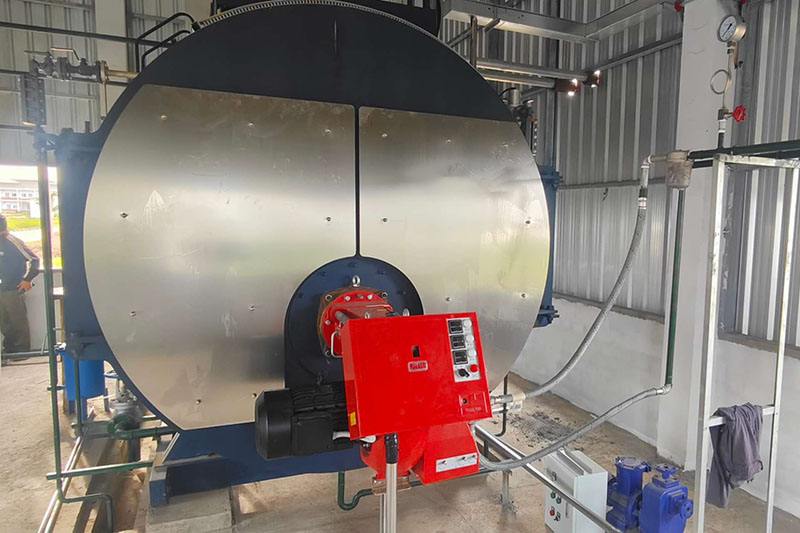
- Typically below 25 bar
- Up to 20 tons/hour steam capacity
Water Tube Boilers
- Can exceed 100 bar pressure
- Suitable for large industrial output
Expert Insight
Industrial boiler selection should focus on lifecycle cost rather than initial purchase price.
Facilities with continuous steam demand often achieve better long-term savings using water tube boilers due to fuel efficiency and load adaptability.
6. Safety Comparison
Fire tube boilers contain a larger volume of pressurized water, meaning stored energy is higher. Water tube boilers distribute water across multiple tubes, reducing explosion risk under high-pressure conditions.
7. How to Choose the Right Boiler
Choose Fire Tube Boiler If:
- Steam demand is small or moderate
- Budget is limited
- Operation simplicity is required
- Low-pressure steam is sufficient
Choose Water Tube Boiler If:
- High-pressure steam is required
- Large industrial production lines operate continuously
- Fuel efficiency is a priority
- Future expansion is planned
8. 結論
Both fire tube and water tube boilers serve essential roles in industrial energy systems. Fire tube boilers provide affordability and simplicity, while water tube boilers deliver superior performance for high-capacity operations.
Selecting the correct boiler type improves operational efficiency, enhances safety, and reduces long-term energy costs.

適切なボイラーの選択にサポートが必要?
接触 私たちのエンジニアリングチームは、 ボイラー選定無料相談 カスタマイズされた蒸気システムソリューション. ワッツアップ: +86 138 3822 5665
よくある質問 (よくある質問)
1. Which is better: fire tube or water tube boiler?
Neither boiler is universally better. Fire tube boilers are ideal for small and medium steam demand due to their lower cost and simple operation, while water tube boilers are better suited for high-pressure and large-capacity industrial applications requiring higher efficiency.
2. Why are water tube boilers more efficient?
Water tube boilers provide a larger heat transfer surface and better water circulation, allowing faster heat absorption and improved combustion control. This typically results in 5–10% higher thermal efficiency compared to fire tube boilers.
3. Are fire tube boilers safer than water tube boilers?
Fire tube boilers operate safely under low-pressure conditions, but water tube boilers are generally considered safer for high-pressure operations because they contain less water volume in each tube, reducing stored energy risks.
4. What industries commonly use fire tube boilers?
Fire tube boilers are widely used in food processing, textile manufacturing, laundry services, 病院, and commercial heating systems where stable low to medium pressure steam is required.
5. When should I choose a water tube boiler?
A water tube boiler is recommended when industries require continuous steam production, 高圧, rapid load response, or large steam capacity such as power plants, chemical factories, and oil & gas facilities.
6. Which boiler has lower operating costs?
Although fire tube boilers have lower initial investment costs, water tube boilers often achieve lower long-term operating costs due to higher fuel efficiency and better performance under continuous operation.
7. What is the lifespan of fire tube vs water tube boilers?
適切なメンテナンスを行うことで, fire tube boilers typically last 15–20 years, while water tube boilers can operate for 20–30 years depending on water treatment quality, 動作条件, and maintenance practices.
8. Can a fire tube boiler replace a water tube boiler?
Replacement depends on steam pressure and capacity requirements. Fire tube boilers may replace water tube boilers only in lower-demand applications. High-pressure industrial systems usually require water tube designs.

