
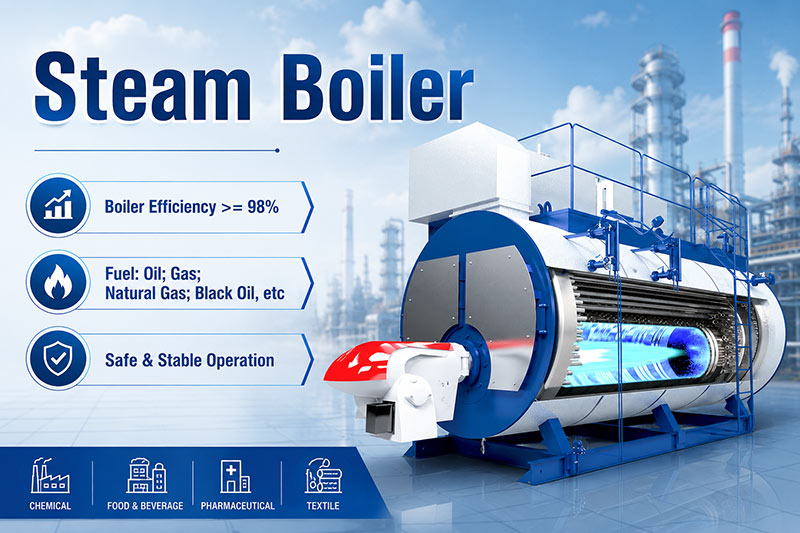
What Is a Steam Boiler?
A steam boiler is a machine that heats water to produce steam. The steam is then used in factories, power plants, food processing lines, textile mills, chemical plants, and many other industries.
Even in 2026, steam boilers are still one of the most important industrial systems in the world. Many factory processes need stable heat and steam pressure, and a steam boiler can provide both.
Today, modern steam boilers are becoming:
- More energy efficient
- More environmentally friendly
- Easier to control automatically
- Safer for long-term operation
Because fuel prices continue to rise in many countries, companies now pay more attention to steam boiler efficiency, fuel consumption, and maintenance cost.
How Does a Steam Boiler Work?
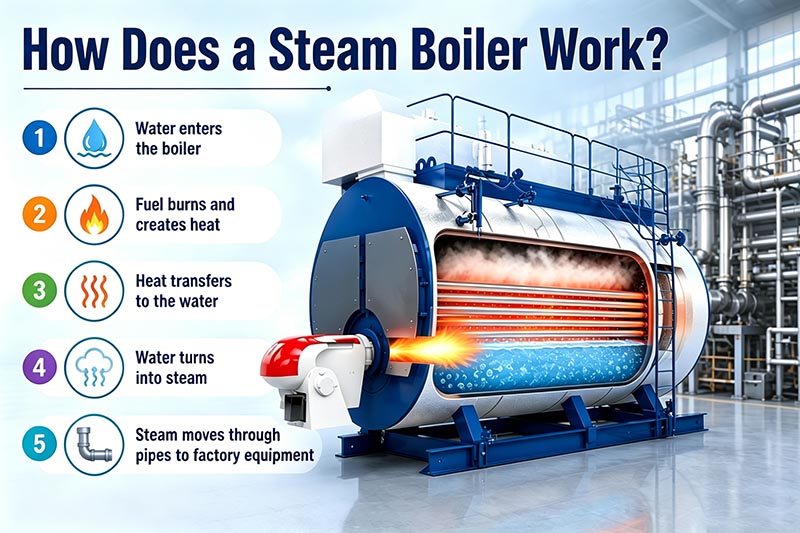
A steam boiler works by heating water inside a closed system until steam is produced.
The basic process is simple:
- Water enters the boiler
- Fuel burns and creates heat
- Heat transfers to the water
- Water turns into steam
- Steam moves through pipes to factory equipment
The steam can then be used for:
- Heating
- Sterilization
- Drying
- Cooking
- Power generation
- Chemical reactions
Modern industrial steam boilers usually include:
- Burner system
- Combustion chamber
- Heat exchanger
- Water pump
- Steam drum
- Safety valves
- PLC automatic control system
A good steam boiler should provide:
- Stable steam pressure
- Fast steam generation
- Low fuel consumption
- Safe operation
Main Types of Steam Boilers
Different factories use different types of steam boilers depending on fuel, pressure, and production needs.
Fire Tube Steam Boiler
A fire tube boiler sends hot gas through tubes surrounded by water.
Advantages
- Simple structure
- Lower cost
- Easy maintenance
- Good for small and medium factories
Applications
- Food factories
- Laundry plants
- Hotels
- Small textile mills
Fire tube boilers are popular because they are easy to install and operate.
Water Tube Steam Boiler
A water tube boiler works differently. Water flows inside the tubes, while hot gas heats the outside.
Advantages
- Higher pressure
- Larger steam capacity
- Faster heat transfer
- Better for continuous industrial production
Applications
- Power plants
- Chemical factories
- Large textile factories
- Heavy industry
Water tube boilers are commonly used in large industrial projects because they can produce a large amount of steam continuously.
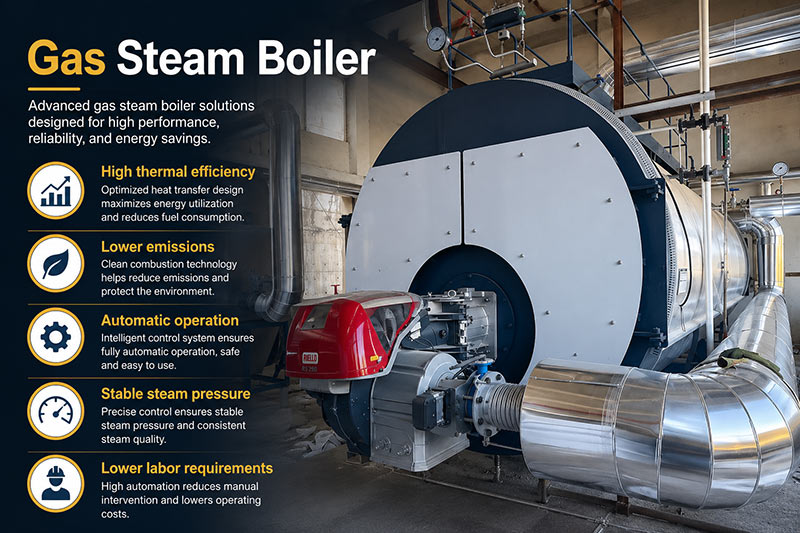
Gas Steam Boiler
Gas steam boilers use natural gas, LNG, or LPG as fuel.
These boilers are becoming more popular worldwide because they are cleaner and more efficient.
Advantages
- High thermal efficiency
- Lower emissions
- Fully automatic operation
- Stable steam output
- Lower maintenance cost
Suitable Industries
- Food processing
- Pharmaceutical industry
- Textile industry
- Hospitals
Many factories in Saudi Arabia, Southeast Asia, and Europe now prefer gas fired steam boilers because environmental regulations are becoming stricter.
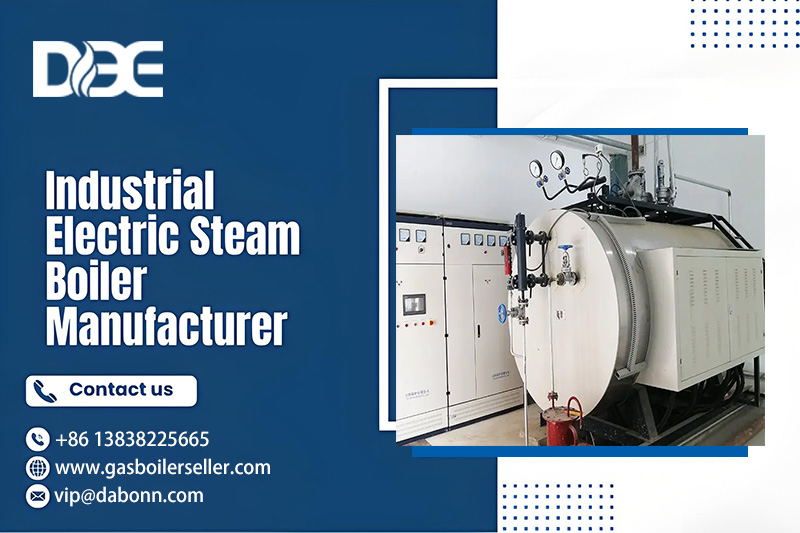
Electric Steam Boiler
Electric steam boilers use electricity instead of fuel combustion.
Advantages
- No direct emissions
- Very clean operation
- Quiet working environment
- Compact design
Limitations
- Higher electricity cost in some countries
- Usually smaller capacity
Best Applications
- Laboratories
- Pharmaceutical plants
- Small food factories
- Clean steam applications
Electric steam boilers are becoming more common in industries that need clean and precise steam control.
Biomass Steam Boiler
Biomass steam boilers use renewable fuels such as:
- Wood chips
- Coconut shell
- Rice husk
- Palm shell
- Sawdust
Advantages
- Lower fuel cost
- Renewable energy
- Reduced dependence on fossil fuels
Challenges
- Fuel storage space
- Ash cleaning
- Fuel moisture control
Biomass boilers are especially popular in agricultural countries where biomass fuel is easy to obtain.
Steam Boiler Applications in Different Industries
Steam boilers are used in many industries around the world.
Food Industry
The food industry needs steam for:
- Cooking
- Sterilization
- Cleaning
- Packaging
- Drying
A stable steam supply helps improve food quality and production efficiency.
Gas steam boilers and electric steam boilers are both commonly used in food factories.
Textile Industry
Textile factories use steam for:
- Dyeing
- Fabric drying
- Ironing
- Heat setting
Bangladesh is one of the largest textile manufacturing countries, and many textile plants use industrial steam boilers for daily production.
Stable steam pressure is very important in textile processing because it directly affects fabric quality.
Pharmaceutical Industry
Pharmaceutical factories need very clean steam.
Steam is used for:
- Sterilization
- Equipment cleaning
- Production heating
This industry usually requires:
- High safety standards
- Automatic control systems
- Clean steam systems
Chemical Industry
Chemical plants often require high temperature and stable heating.
Steam boilers are used for:
- Chemical reactions
- Distillation
- Material heating
- Process temperature control
Large water tube boilers are commonly used in chemical industries because they can operate continuously for long periods.
Power Generation
Steam boilers are also used in power plants.
The steam drives steam turbines to generate electricity.
Large industrial boilers used in power stations usually operate under high pressure and high temperature conditions.
Steam Boiler Fuel Comparison
Different fuels affect operating cost, efficiency, and emissions.
| Fuel Type | Efficiency | Operating Cost | Emissions | Automation |
|---|---|---|---|---|
| Natural Gas | High | Medium | Low | High |
| Electricity | Very High | High | Zero | Very High |
| Biomass | Medium | Low | Medium | Medium |
| Coal | Lower | Low | High | Low |
Choosing the right fuel depends on:
- Local fuel price
- Environmental regulations
- Factory budget
- Steam demand
- Available infrastructure
For example:
- Gas boilers are popular in cities with stable gas supply
- Biomass boilers are suitable for agricultural areas
- Electric boilers work well in clean industries
Looking for a Steam Boiler?
Contact us today for a customized oil hot water boiler solution and free energy efficiency assessment. Our expert engineering team provides full support from design to installation.
Steam Boiler Efficiency Explained
Efficiency is one of the most important topics when choosing a steam boiler.
A high efficiency steam boiler can save a large amount of fuel every year.
What Affects Boiler Efficiency?
Several factors influence steam boiler efficiency:
Burner Quality
A good burner improves fuel combustion and reduces waste.
Heat Loss
Some heat escapes through exhaust gas.
Lower exhaust temperature usually means better efficiency.
Water Quality
Poor water quality causes scale buildup inside the boiler.
Scale reduces heat transfer efficiency.
Boiler Insulation
Good insulation reduces heat loss from the boiler surface.
Automatic Control System
Modern PLC systems can adjust fuel and air automatically to improve efficiency.
How to Reduce Steam Boiler Fuel Consumption
Factories can reduce fuel cost by:
- Using economizers
- Recovering waste heat
- Maintaining proper combustion
- Cleaning heat exchange surfaces
- Using automatic oxygen control
- Checking steam pipe insulation regularly
Even small efficiency improvements can save thousands of dollars every year.
How Much Does a Steam Boiler Cost in 2026?
Steam boiler prices vary depending on:
- Capacity
- Fuel type
- Pressure
- Automation level
- Manufacturing quality
Typical Cost Factors
Initial Purchase Cost
Larger boilers cost more.
Installation Cost
Includes:
- Piping
- Chimney
- Water treatment
- Electrical system
Fuel Cost
Fuel is usually the biggest long-term expense.
Maintenance Cost
Regular maintenance helps avoid major repair problems.
Why Cheap Boilers Can Cost More Later
Some low-price boilers may:
- Consume more fuel
- Require frequent repairs
- Have shorter lifespan
- Lack safety systems
Many factories now focus on total lifecycle cost instead of only purchase price.
A reliable high efficiency boiler can save much more money over time.
How to Choose the Right Steam Boiler
Choosing the correct steam boiler is very important for factory efficiency.
Consider Steam Capacity
The boiler must match actual steam demand.
A boiler that is too small cannot support production.
A boiler that is too large wastes fuel.
Consider Fuel Availability
Different countries have different energy conditions.
For example:
- Natural gas is common in the Middle East
- Biomass fuel is common in agricultural regions
- Electricity may be expensive in some countries
Consider Environmental Regulations
Many countries now require:
- Lower NOx emissions
- Cleaner combustion
- Energy-saving systems
Modern gas steam boilers are often preferred because they produce lower emissions.
Consider Automation
Automatic boilers reduce labor cost and improve safety.
Modern PLC systems can provide:
- Remote monitoring
- Automatic alarm systems
- Touchscreen control
- Real-time data analysis
Common Steam Boiler Problems
Even a good boiler needs regular maintenance.
Unstable Steam Pressure
Possible reasons:
- Burner problems
- Incorrect load matching
- Poor control settings
Scale Buildup
Poor water treatment can cause scale inside the boiler.
This reduces heat transfer and increases fuel consumption.
High Exhaust Temperature
Usually indicates heat loss or dirty heating surfaces.
Water Level Problems
Incorrect water level can affect boiler safety.
Modern boilers usually include automatic water level protection systems.
Why Factories Choose Dabonn Energy
Dabonn Energy provides industrial boiler solutions for customers worldwide.
The company focuses on:
- Gas steam boilers
- Electric steam boilers
- Biomass boilers
- Thermal oil boilers
Customized Boiler Solutions
Different industries require different steam systems.
Dabonn Energy provides customized solutions based on:
- Fuel type
- Steam capacity
- Local regulations
- Factory layout
- Energy-saving requirements
International Project Experience
Dabonn Energy has experience serving industries such as:
- Textile factories
- Food processing plants
- Chemical plants
- Manufacturing industries
The company also supports overseas installation and technical service.
Focus on Energy Saving
Modern industrial users care more about:
- Fuel efficiency
- Emission reduction
- Stable operation
- Long equipment lifespan
Dabonn Energy focuses on providing boilers with:
- High thermal efficiency
- Intelligent control systems
- Stable steam output
- Lower operating cost
Future Trends of Steam Boilers
The steam boiler industry is changing quickly.
Smart Boiler Systems
More factories now use:
- IoT remote monitoring
- AI-based control systems
- Real-time performance analysis
Lower Emissions
Governments around the world are introducing stricter environmental policies.
This increases demand for:
- Low NOx burners
- Condensing boilers
- Cleaner fuel systems
Renewable Energy
Biomass boilers and hybrid energy systems are becoming more popular.
Many factories are trying to reduce carbon emissions and improve sustainability.
Frequently Asked Questions (FAQ)
What is the most efficient steam boiler?
Modern gas fired condensing boilers and electric steam boilers are usually the most efficient options.
Which fuel is best for industrial steam boilers?
Natural gas is one of the best choices because it offers high efficiency, clean combustion, and stable operation.
How long does a steam boiler last?
A well-maintained industrial steam boiler can typically last 15–25 years.
What industries use steam boilers?
Steam boilers are widely used in food, textile, pharmaceutical, chemical, and power generation industries.
How much fuel does a steam boiler consume?
Fuel consumption depends on boiler size, efficiency, operating pressure, and fuel type.
What is the difference between fire tube and water tube boilers?
Fire tube boilers are simpler and suitable for smaller applications, while water tube boilers handle higher pressure and larger steam capacity.
Conclusion
Steam boilers remain one of the most important systems in modern industry.
From food factories to textile plants and power stations, steam boilers continue to provide stable and efficient energy for industrial production.
When choosing a steam boiler, factories should not only consider price. They should also evaluate:
- Efficiency
- Fuel consumption
- Automation
- Maintenance
- Long-term operating cost
Modern high efficiency steam boilers can greatly reduce fuel use and improve production stability.
If you are looking for industrial steam boiler solutions, Dabonn Energy provides customized systems for different industries and fuel types worldwide. WhatsApp: +86 13838225665


