
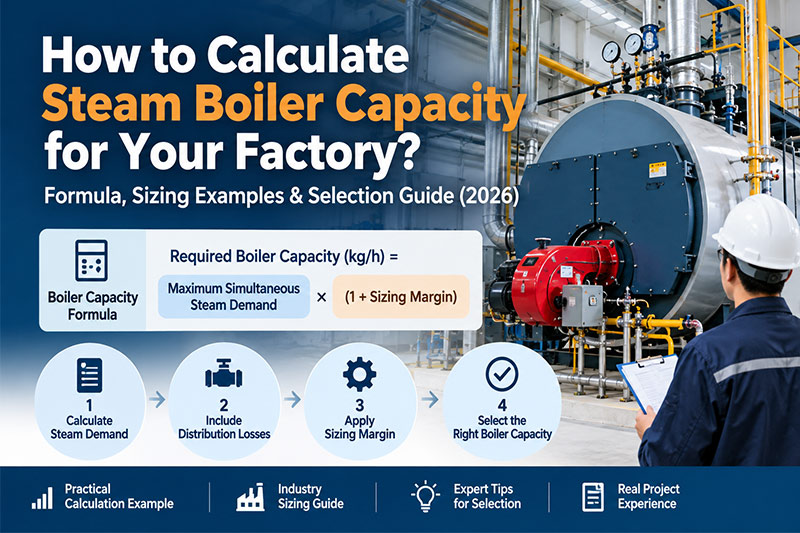
Choosing the wrong steam boiler capacity can increase fuel costs, interrupt production, and lead to unnecessary equipment investment. An undersized boiler may fail to meet peak steam demand, while an oversized boiler can operate inefficiently at low loads.
To calculate steam boiler capacity, determine the total simultaneous steam demand of your factory, account for distribution losses and peak operating conditions, and select a boiler with an appropriate capacity margin. For preliminary industrial boiler sizing, a 10–20% margin above the calculated operating demand may be considered, but the final margin should depend on actual load fluctuations, boiler turndown capability, standby requirements, and process conditions.
Par exemple, if a factory requires 4,500 kg/h of steam and applies a 15% preliminary sizing margin, its calculated capacity is:
4,500 × 1.15 = 5,175 kg/heure (5.175 tonnes/heure).
This result provides a starting point for evaluating suitable boiler configurations rather than automatically selecting the next larger nominal capacity.
This guide explains the steam boiler capacity calculation formula, common sizing units, practical factory examples, and important factors to consider before purchasing an chaudière à vapeur industrielle.
What Is Steam Boiler Capacity?
Steam boiler capacity refers to the amount of steam a boiler can produce within a specified period under defined operating conditions. It is normally expressed in kilograms per hour (kg/heure) or metric tons per hour (ème).
Par exemple, a 5-ton steam boiler is nominally rated to generate 5,000 kg of steam per hour under its specified design and rating conditions.
Cependant, actual steam output depends on several factors, y compris:
- Steam operating pressure and temperature
- Température de l'eau d'alimentation
- Fuel quality and available heat input
- Boiler efficiency and operating load
- Manufacturer rating conditions
Donc, factories should evaluate both nominal boiler capacity and the actual steam generation conditions required by their production processes.
What Units Are Used to Measure Steam Boiler Capacity?
Different manufacturers and engineering specifications may express boiler capacity using different units.
| Unité | Meaning | Conversion |
|---|---|---|
| kg/heure | Kilograms of steam per hour | 1,000 kg/h = 1 ème |
| ème | Metric tons of steam per hour | 1 t/h = 1,000 kg/heure |
| lb/h | Pounds of steam per hour | 1 t/h ≈ 2,204.62 lb/h |
| Boiler HP (BHP) | Traditional boiler output rating | 1 BHP ≈ 15.65 kg/h of steam from and at 100°C |
| kW | Thermal output rating | Depends on steam and feedwater enthalpy |
Pour chaudière à vapeur industrielle sélection, kg/h and t/h are generally the most convenient units because they directly describe the required steam mass flow.
Boiler horsepower and thermal power should not be converted into actual steam production without checking the applicable rating conditions.
What Is the Steam Boiler Capacity Calculation Formula?
The first step is to determine how much steam the factory actually needs during normal and peak production.
A practical preliminary sizing formula is:
Required Boiler Capacity (kg/heure) = Maximum Simultaneous Steam Demand × (1 + Sizing Margin)
Où:
- Maximum Simultaneous Steam Demand: Total steam consumption of equipment operating at the same time, including applicable distribution losses.
- Sizing Margin: Additional capacity allowance selected according to load variation, demand uncertainty, and operational requirements.
For factories with several steam-consuming machines, the simultaneous demand can be estimated as:
Maximum Simultaneous Steam Demand = Σ (Equipment Steam Consumption × Simultaneous Operating Factor) + Distribution Losses
The simultaneous operating factor represents the portion of an equipment load expected to occur during the design peak period. It must be based on the actual production schedule rather than an arbitrary percentage.
Important: Standby or redundancy requirements should be evaluated separately. UN 15% capacity margin does not replace a backup boiler when continuous steam availability is essential.
How Do You Calculate Steam Demand for a Factory?
Before selecting a steam boiler, list all equipment that requires steam and identify when each process operates.
Typical steam-consuming equipment includes:
- Industrial cooking and heating vessels
- Échangeurs de chaleur
- Textile dyeing and finishing machines
- Dryers and sterilizers
- Cleaning and washing systems
- Steam tracing and process heating equipment
Steam consumption should ideally be obtained from equipment specifications, heat-balance calculations, existing steam flow meters, or production records.
Simply adding the maximum nameplate steam demand of every machine may result in an oversized boiler if the equipment does not operate simultaneously.
Steam Boiler Capacity Calculation Example: Usine de transformation des aliments
Consider a food processing factory that uses steam for cooking, stérilisation, hot water preparation, and cleaning.
The following figures are illustrative engineering assumptions used to demonstrate the calculation method. They are not measured operating data from a specific factory.
Étape 1: Identify Equipment Steam Consumption
| Steam-Using Equipment | Rated Steam Demand | Peak Simultaneous Factor | Calculated Demand |
|---|---|---|---|
| Cooking equipment | 1,800 kg/heure | 100% | 1,800 kg/heure |
| Sterilization system | 1,200 kg/heure | 100% | 1,200 kg/heure |
| Hot water preparation | 800 kg/heure | 75% | 600 kg/heure |
| Cleaning equipment | 500 kg/heure | 60% | 300 kg/heure |
| Total | 4,300 kg/heure | — | 3,900 kg/heure |
The calculated maximum simultaneous equipment demand is:
1,800 + 1,200 + 600 + 300 = 3,900 kg/heure
Étape 2: Account for Steam Distribution Losses
Assume an additional 5% allowance for estimated steam distribution losses in this preliminary example.
Calculated demand at the boiler outlet:
3,900 × 1.05 = 4,095 kg/heure
The factory therefore needs approximately 4.095 t/h of steam at the boiler outlet during the assumed peak period.
Étape 3: Apply an Appropriate Sizing Margin
Assume a preliminary 15% capacity margin to accommodate reasonable demand uncertainty and operating variation.
Required boiler capacity:
4,095 × 1.15 = 4,709.25 kg/heure
Converted into metric tons per hour:
4,709.25 ÷ 1,000 ≈ 4.71 ème
Étape 4: Evaluate the Boiler Configuration
Based on this illustrative calculation, a nominal 5 t/h steam boiler may be a suitable starting point for technical evaluation, provided its rated output can be achieved under the required steam pressure, température de l'eau d'alimentation, and fuel conditions.
The final selection should also verify the startup demand, operating schedule, minimum load, steam quality, future expansion plans, and whether a standby boiler is required.
How Does Steam Pressure Affect Boiler Capacity?
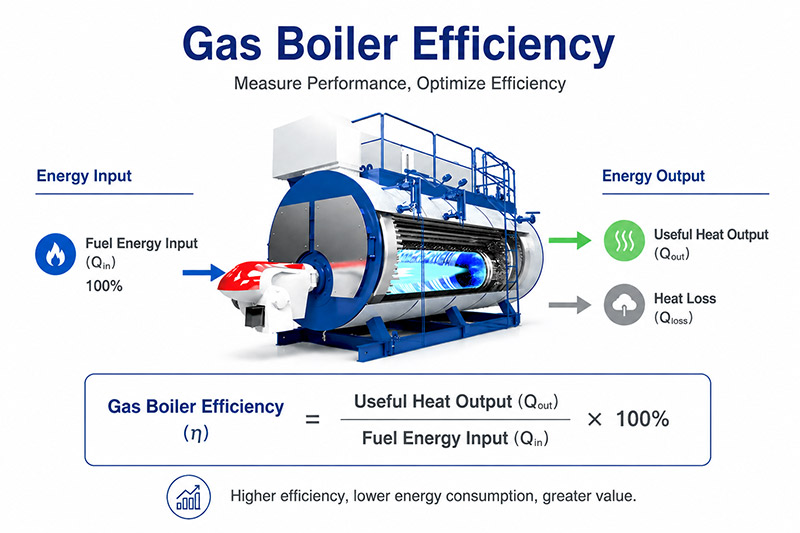
Steam pressure affects the energy required to generate steam. A boiler that produces steam at a higher pressure may require more heat input for the same steam mass flow, depending on feedwater conditions and the required steam state.
For an energy-based capacity calculation, engineers can use:
Required Useful Heat Input (kW) = Steam Mass Flow (kg/heure) × (Steam Enthalpy − Feedwater Enthalpy) (kJ/kg) ÷ 3,600
The fuel-side heat input can then be estimated as:
Required Fuel Heat Input (kW) = Required Useful Heat Input ÷ Boiler Efficiency
For accurate calculations, steam enthalpy must correspond to the specified pressure and steam condition, while feedwater enthalpy must correspond to the actual feedwater temperature.
Boiler efficiency and fuel heating value must also use a consistent measurement basis, such as lower heating value (PCI) or higher heating value (PCS).
This is why a factory should provide both its required steam capacity and operating pressure when requesting a boiler quotation.
What Happens If a Steam Boiler Is Oversized or Undersized?
Incorrect boiler sizing can create long-term operational problems.
| Condition | Potential Problems |
|---|---|
| Oversized boiler | Higher initial investment, unnecessary equipment capacity, frequent cycling, and inefficient low-load operation |
| Undersized boiler | Insufficient steam supply, pressure fluctuations, production delays, and difficulty meeting peak demand |
| Correctly sized boiler | More stable steam supply, better load matching, and improved operating flexibility |
Cependant, a boiler should not be selected solely to operate near its maximum rating. The ideal configuration depends on the factory’s complete load profile, including minimum, average, and peak steam demand.
For facilities with significant demand fluctuations, multiple boilers or a modular boiler arrangement may offer better operational flexibility than a single large unit.
What Boiler Capacity Is Suitable for Different Industries?
Steam requirements vary considerably between industries, even when factories have similar production volumes.
| Industrie | Common Steam Applications | Important Sizing Considerations |
|---|---|---|
| Transformation des aliments | Cuisson, stérilisation, nettoyage, and hot water preparation | Batch production, startup demand, and simultaneous equipment operation |
| Industrie textile | Teinture, lavage, séchage, et finition | Production-line schedules and peak process demand |
| Industrie chimique | Reactor heating, distillation, and process temperature control | Required pressure, fonctionnement continu, and process stability |
| Industrie du papier | Séchage et chauffage de processus | Continuous steam demand and load fluctuations |
| Industrie pharmaceutique | Chauffage de processus, stérilisation, and cleaning | Steam quality, fiabilité, and process requirements |
There is no universally correct boiler capacity for an entire industry. Equipment specifications and production schedules are more reliable than selecting a boiler based only on factory size or industry category.
Should You Choose One Large Boiler or Multiple Smaller Boilers?
For factories with variable steam consumption, boiler configuration is just as important as total installed capacity.
A single large boiler may offer a simpler equipment arrangement, while multiple smaller boilers can provide flexibility when demand changes throughout the day.
Par exemple, a factory with a 4 t/h peak steam requirement might evaluate a single appropriately sized boiler or a multiple-boiler arrangement, depending on its minimum operating load and reliability requirements.
Multiple boilers may allow operators to start or stop individual units as demand changes. They can also provide partial steam availability during planned maintenance, although full standby capacity requires a separately designed redundancy strategy.
The correct choice should consider:
- Minimum and maximum steam demand
- Daily and seasonal load variation
- Boiler burner turndown ratio
- Exigences d'entretien
- Espace d'installation disponible
- Initial investment and operating costs
- Required steam supply reliability

What Information Should You Provide Before Selecting a Steam Boiler?
To obtain a more accurate industrial steam boiler recommendation, prepare the following information before contacting a manufacturer:
- Required steam output in kg/h or t/h
- Required operating pressure and steam temperature
- Factory equipment list and individual steam consumption
- Normal and peak operating schedules
- Available fuel type and fuel specifications
- Feedwater temperature and condensate recovery conditions
- Daily operating hours and annual operating days
- Future production expansion and standby requirements
These details help engineers calculate the required steam output, assess boiler efficiency, and recommend a suitable system configuration.
À la recherche d'une chaudière industrielle?
Contactez-nous aujourd'hui pour un personnalisé chaudière industrielle solution et évaluation gratuite de l’efficacité énergétique. Notre équipe d’ingénieurs experts fournit une assistance complète de la conception à l’installation.
Dabonn Energy Steam Boiler Sizing and Project Experience
Dabonn Energy provides industrial steam boiler solutions for food processing, textile, chimique, and other manufacturing applications.
Our boiler product range includes gas-fired steam boilers, oil-fired steam boilers, chaudières à biomasse, and complete industrial steam generation systems.
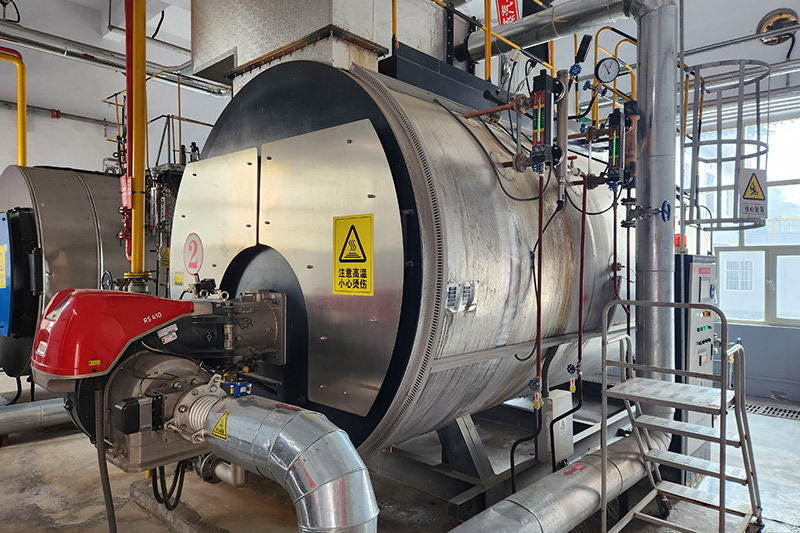
One relevant application is a hot pot seasoning manufacturing facility supplied with two 2-ton steam boilers for food production processes.
This project illustrates an important boiler sizing consideration: factories should evaluate not only total installed steam capacity but also their production schedule, process demand, and equipment configuration.
For each new project, Dabonn Energy can evaluate the customer’s stated steam demand, conditions de carburant, pression de service, and production requirements to support boiler capacity selection.
Instead of selecting equipment based only on nominal tonnage, an appropriate technical evaluation helps customers balance steam availability, investment cost, and long-term operating efficiency.
Need help calculating the right steam boiler capacity for your factory? Send your steam demand, pression de service, type de carburant, and production schedule to Dabonn Energy for a customized boiler recommendation.
E-mail: [email protected]
Conclusion: How Do You Choose the Right Steam Boiler Capacity?
Accurate steam boiler capacity calculation begins with understanding the factory’s actual steam demand rather than choosing equipment based only on estimated production scale.
The recommended preliminary method is to calculate maximum simultaneous steam consumption, include applicable distribution losses, and apply a justified sizing margin.
In the illustrative transformation des aliments exemple, a calculated equipment demand of 3,900 kg/h increased to approximately 4.71 t/h after accounting for estimated distribution losses and a preliminary capacity margin.
Cependant, the final boiler selection must also consider operating pressure, feedwater conditions, peak demand, minimum load, and steam supply reliability.
By combining accurate steam demand calculations with professional boiler system evaluation, factories can avoid unnecessary investment while maintaining stable and efficient steam production.
Frequently Asked Questions About Steam Boiler Capacity Calculation
1. How do you calculate steam boiler capacity?
Calculate the maximum simultaneous steam demand of all operating equipment, include applicable distribution losses, and apply a justified sizing margin. The result can be expressed in kg/h or metric tons per hour.
2. How many tons of steam boiler does my factory need?
The required boiler capacity depends on your factory’s peak steam consumption, operating schedule, pression de vapeur, and future expansion requirements. An equipment-level steam demand calculation is more accurate than choosing capacity based only on factory size.
3. What is the formula for steam boiler sizing?
A preliminary formula is: Required Boiler Capacity = Maximum Simultaneous Steam Demand × (1 + Sizing Margin). Distribution losses should be included in the demand calculation where applicable.
4. How many kilograms of steam can a 1-ton boiler produce per hour?
A nominal 1 t/h steam boiler is rated to produce 1,000 kg of steam per hour under its specified rating conditions. Actual output must be checked against the required steam pressure, température de l'eau d'alimentation, and manufacturer specifications.
5. Is a 10–20% boiler capacity margin always necessary?
Non. A 10–20% margin may be useful for preliminary estimates, but the correct allowance depends on demand uncertainty, variation de charge, startup requirements, and future expansion. Excessive margins can result in unnecessary oversizing.
6. Does higher steam pressure require a larger boiler?
Higher steam pressure changes the energy required to produce steam. Whether a larger boiler or greater fuel heat input is needed depends on the required steam mass flow, température de l'eau d'alimentation, steam condition, and equipment rating.
7. Is one large steam boiler better than two smaller boilers?
Neither arrangement is universally better. Multiple boilers may improve load flexibility and maintenance planning, while a single boiler may simplify the equipment arrangement. The best option depends on the factory’s steam demand profile and reliability requirements.
8. What information does a boiler manufacturer need for capacity selection?
A manufacturer normally needs the required steam output, pression de service, température de la vapeur, type de carburant, equipment steam demand, heures d'ouverture, feedwater conditions, and any standby or expansion requirements.


